The Maldegem Castle
The Maldegem Castle (also spelled Maldeghem, Flemish pronunciation: “Maldehem”), today the building of the Novi Kneževac Cultural Centre, was built in 1910 for the Count Maldegem (Maldeghem) family, after whom the building was named. For several decades now, the “Branislav Nušić” Public Library of Novi Kneževac has been housed in the Maldegem Castle, making it a focal point of the town’s major cultural events.
The Maldegem Castle (also spelled Maldeghem, Flemish pronunciation: “Maldehem”), today the building of the Novi Kneževac Cultural Centre, was built in 1910 for the Count Maldegem (Maldeghem) family, after whom the building was named. For several decades now, the “Branislav Nušić” Public Library of Novi Kneževac has been housed in the Maldegem Castle, making it a focal point of the town’s major cultural events.
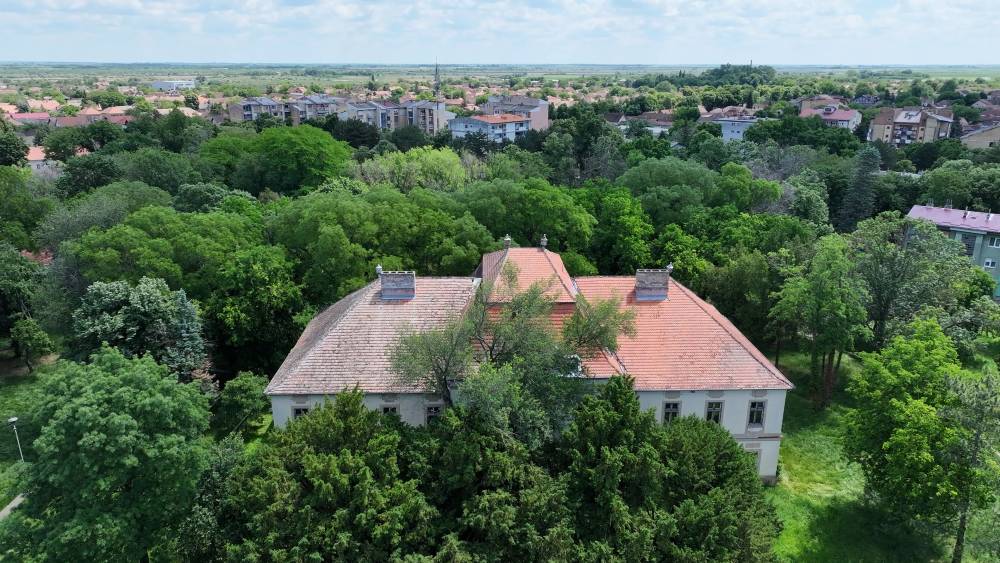
It is located in a monumental park, a protected landscape architecture monument, which contains as many as four castles: this one, the Servijski–Šulpe Castle, and two castles of the Talijan family, now in ruins. The noble Maldegem family originates from Belgium, specifically from a town in West Flanders that bears the same name—Maldegem. Their connection with Austria lies in the fact that Flanders was also part of the Habsburg domains, i.e., the Spanish Netherlands. It was during that period, throughout the 16th and 17th centuries, that the Maldegem family reached its greatest prominence.
They decided to move to the “promising East” a couple of centuries later: the first to arrive in what was then Turkish Kanjiža was Count Artur Maldegem, an officer and Doctor of Law, although he did not remain there. The family genealogy states the following:
“Artur married Georgina Bayer, daughter of Oto Bayer and Albertina, née Šulpe, from Turkish Kanjiža. Artur Maldegem’s father was Karl Maldegem, a knight of the Order of Malta from Münster and a participant in the Napoleonic wars. As Napoleon’s page, he had to deliver the news of the defeat at Waterloo to the Parisians on 18 June 1815. Count Artur Maldegem was born in 1835 in Niederstotzingen, Germany. After marrying Georgina Bayer, he lived in Pozsony, today’s Bratislava. Their only son, Artur Jr., was born in Pozsony in 1869. He later married Vilma from the aristocratic Bethlem family, who bore him four children. Artur Jr. died at the age of 34, leaving behind his wife Vilma with four children and his parents.”
A rather complex and impressive lineage. After her son's death, Georgina decided to return to northern Banat and build a summer residence so she could be closer to her relatives. In Turkish Kanjiža, Georgina owned 1,880 jutros of land inherited from her mother, Albertina Šulpe. She began the construction of the castle in 1904, but unfortunately did not live to see its completion in 1910: she died in 1907.
After the death of her mother-in-law Georgina, Vilma Maldegem came to Turkish Kanjiža with her four children — Marija (1896), twins Karl and Georgina (1897), and Albertina (1901) — to oversee the completion of the castle. In Turkish Kanjiža she received help from relatives, so she entrusted guardianship of the children to Emil and Bela Talijan, who also assisted with the completion of the castle.
Of the four children, only two remained in Novi Kneževac. Albertina, known as Berta, who later married Tibor Talijan, a distant relative of her guardians, and Karl, who returned to his estate after finishing his education in Pozsony. Count Karl Maldegem earned a doctorate in political science, but had no great ambitions. He never married, did not engage in politics, was kind and approachable, and enjoyed hunting, reading, and socializing. He was not particularly interested in managing the estate, which included vegetable and grain production, cattle, pigs, horses, and carp farming. The product the Maldegem family was especially proud of was red paprika, for which Novi Kneževac is still known today (the “Aleva” factory continues this tradition).
After the First World War, his property was reduced to 713 jutros, which was still sufficient for the Count to live comfortably until the beginning of the Second World War. Count Maldegem was a determined anti-fascist and helped both Serbs and Hungarians survive the famine years of the war. Even though it was well-known whose side he was on, at the end of the Second World War he was captured and placed on the list for execution, but some locals managed to free him and save him from being shot.
Albertina died on 7 October 1944 on the ferry behind the Talijan Castle. The castle was looted, and a pyre near the building consumed 7,000 books from the Maldegem family library. Valuable furniture, jewelry, porcelain, and artworks — including two paintings by Rubens — were taken. Ironically, much of this was done by the very same people whom the Count had helped during the war when they had nothing to eat.
After the liberation, the Count performed all sorts of jobs in order to survive. He carried water, chopped wood, worked as a stoker, and took on various physical tasks — just to earn a piece of bread. In 1961, Count Karl Maldegem decided to leave the country and move to Germany to be with his relatives. He returned shortly before his death, after eight years, to see his beloved Banat one last time. He died in 1970 in Meinhofen, Germany, and was buried in the family chapel in Niederstotzingen.
Before the Maldegem Castle became home to the library, it housed, at various times after the Second World War, a hospital, a boarding school, the police administration, and a bank. Next to the side entrance, a marble plaque with a relief depicting St. Hubert, patron saint of hunters, and a stag remains embedded in the wall. Vilma Bethlem, mother of Count Karl Maldegem, brought it from Transylvania from her noble family’s estate.
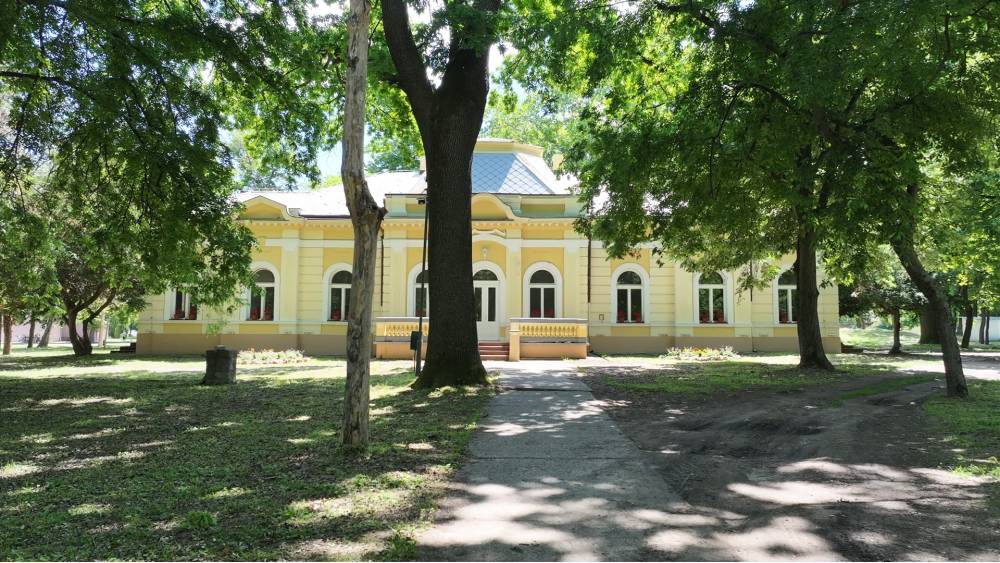
The Maldeghem Castle was built as a free-standing, single-storey structure surrounded by a groomed park that still contains rare tree species, and in front of it are the remains of a round fountain. Its basic concept follows the idea of a “Polish manor house,” typical of the eclectic style popular in the late 19th and early 20th centuries, depending largely on the imagination of the client and architect. It has a rectangular floor plan, with an approximately symmetrical layout, except for small deviations in the interior. It is longitudinally oriented, with a mansard-type elevation at the central part of the roof.
Architecture experts describe it as follows:
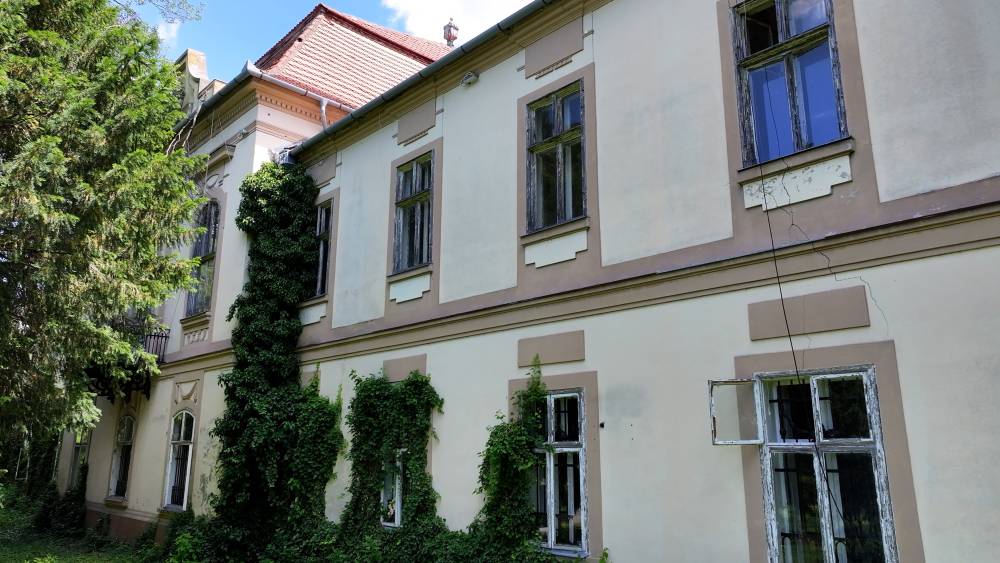
“The main entrance on the longitudinal side is placed in a central, shallow risalit which, according to old postcards, once ended in a roof zone with a balustrade on the corners marked by acroteria, and centrally with a wavy Baroque tympanum topped with a vase. At the same level, an irregular triangular attic marked by two side pillars tops the two shallow risalits placed centrally on the side wings. Horizontally, the façade is divided by a cordon-profiled cornice, and a row of dentils runs beneath the attic. The openings on the main façade are symmetrically arranged. On each side of the central entrance, which has been altered over time, there is a sequence of four rhythmically placed arched windows with a ‘T’ sash division. Below the windows there were once balustrades. The openings are marked by fluted pilasters bearing a Secession-style motif in the form of a projecting row of “teeth,” which also appears above the openings, resting on the cordon cornice. The wall surface between the openings is executed in imitation of rectangular stone blocks. In front of the main entrance is a terrace bordered by a stone balustrade. The side façades are treated in the same manner, while the rear façade has been modified over time and today appears as a flat surface with simple, rectangular openings. The roof is complex, covered with eternit tiles, once crowned with acroteria.”
In 2015, the façade, roof, and woodwork were restored. The façade is painted in a striking yellow color. Inside the castle, only one portrait remains that recalls the Maldegem era. The building is in good condition.
Source: dvorcisrbije.rs