Karačonji Castle
The castle whose empty halls we wander through was abandoned near the end of the First World War by Laslo’s great-grandson, Aladar Karačonji. At the end of 1918, during the collapse of Austria-Hungary, a mob stormed the estate, looted the palace, and scattered its inventory. The following year, in 1919, Mihail Rodzianko, a Russian émigré and former president of the Russian Duma, moved into the castle, living there until his death in 1924.
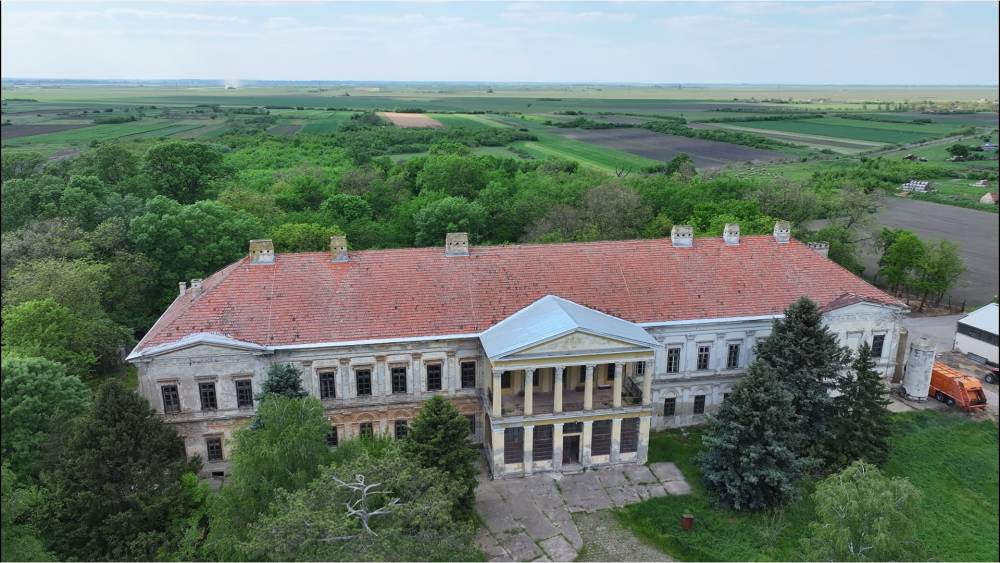
The castle whose empty halls we wander through was abandoned near the end of the First World War by Laslo’s great-grandson, Aladar Karačonji. At the end of 1918, during the collapse of Austria-Hungary, a mob stormed the estate, looted the palace, and scattered its inventory. The following year, in 1919, Mihail Rodzianko, a Russian émigré and former president of the Russian Duma, moved into the castle, living there until his death in 1924.
In 1938, the castle was sold to the municipality of Beodra, which used it as an elementary school. During the Second World War, when Banat was under German occupation, a psychiatric hospital was housed in the castle. After the war, it hosted a home for children of fallen soldiers, a “home for neglected young women” (whatever that meant at the time), and from 1960 onward the “Miloš Popov” Elementary School — traces of this remain in the children’s drawings on the wall beside the central staircase.
In 1980, under someone’s bizarre idea, the chemical-industry company “Hinom” moved into the castle and remained there until 2000, when it went bankrupt. Even today, tanks filled with acids and other chemical substances stand in the former ballrooms and dining halls of the Karačonji palace, and freight elevators for goods were later installed as well. It is simply unbelievable that a palace which, in France, Germany, Austria, or even Hungary, Romania, and Poland, would attract thousands of tourists and employ the local population — served as a factory here.
After 2000, Karačonji Castle has stood unused and in poor condition. Locals say that negotiations are underway with a Turkish company that will supposedly convert it into a luxury spa hotel.
The castle was built by the nobleman and high prefect of Torontal County, Laslo Karačonji, between 1842 and 1846 on his estate in Beodra. But first, a bit of prehistory. The settlement we know today as Novo Miloševo was created by merging two villages — Beodra and Dragutinovo. Dragutinovo was the new name given to the village of Karlovo, named after Dragutin Ristić, a Serbian army colonel from the First World War. Karlovo itself was named after the father of Maria Theresa, Charles IV of Lorraine.
In the 16th century, Karlovo — which did not bear that name at the time — belonged to the feudal lord István Tegeldy, but after several devastating floods it was abandoned and depopulated. It was annexed to the royal chamber estates in 1751, and by 1753 it is recorded that Karlovo was settled by Serbs, primarily those from the disbanded Potisje-Pomorišje Military Frontier. At the first auction of chamber estates, in 1781, the property was purchased by Armenian trader Bogdan Karačonji, who later Magyarized his name, for the price of 105,000 forints. The estate became modern and prosperous, bringing the Karačonji family enormous wealth — enough to build two large castles in Beodra.
The building was constructed as a representative residential palace that, through its spatial layout and architectural concept, holds a dominant position within the expansive park. Architecturally, it is designed and executed consistently in the Classicist style, as are all accompanying buildings on the estate. The structure has an elongated rectangular footprint and is one of the rare two-story residential palaces.
The main façade is symmetrical, with shallow corner risalits topped with pediments. At the center of the main façade is a grand entrance located beneath a portico. In the ground floor, the portico is supported by rectangular Doric columns, while on the upper level — which serves as a large terrace — Corinthian columns with an architrave, plain frieze, and triangular pediment are used.
The ground floor is separated from the upper floor by a horizontal division accentuated with a cordon cornice. Window axes align on both floors and are rhythmically distributed along the façade. The window openings are set between pilasters — Ionic with semicircular stepped pediments on the ground floor, and Corinthian with straight pediments on decorative consoles on the upper floor. The courtyard façade is flat but emphasized by a central glazed section supported by a row of Doric columns. The window axes match, and the side risalits are accentuated by rows of windows.
The estate includes auxiliary economic buildings: stables, barns, storage facilities, and servants’ quarters, which together with the main castle building form an architecturally and stylistically unified and well-coordinated complex. After the Second World War, the castle housed a home for neglected children, a correctional facility, an elementary school, and a household-chemicals factory — the Hinom chemical industry.
The interior was altered to meet factory needs, but it was never completely or properly renovated — owners made inadequate changes to the room layout, especially to the appearance of the rear façade. The castle was once surrounded by a magnificent park, of which little remains today due to heavy devastation caused by the chemical plant.
There was also another, older castle in Beodra, built by Lajoš’s brother, Laslo Karačonji, between 1838 and 1842. Lajoš and Laslo also built the twin-tower church in Beodra (two brothers, two castles, two towers). However, that castle was demolished after the First World War. It too was built in the Classicist style. Both castles are considered to be among the finest examples of European Classicist architecture.
The rear façade of the castle is in quite poor condition. The castle is a protected cultural monument of great importance, but it is in very bad shape and currently has no assigned purpose. The factory has been removed, so the castle is now accessible.
Source: dvorcisrbije.rs


