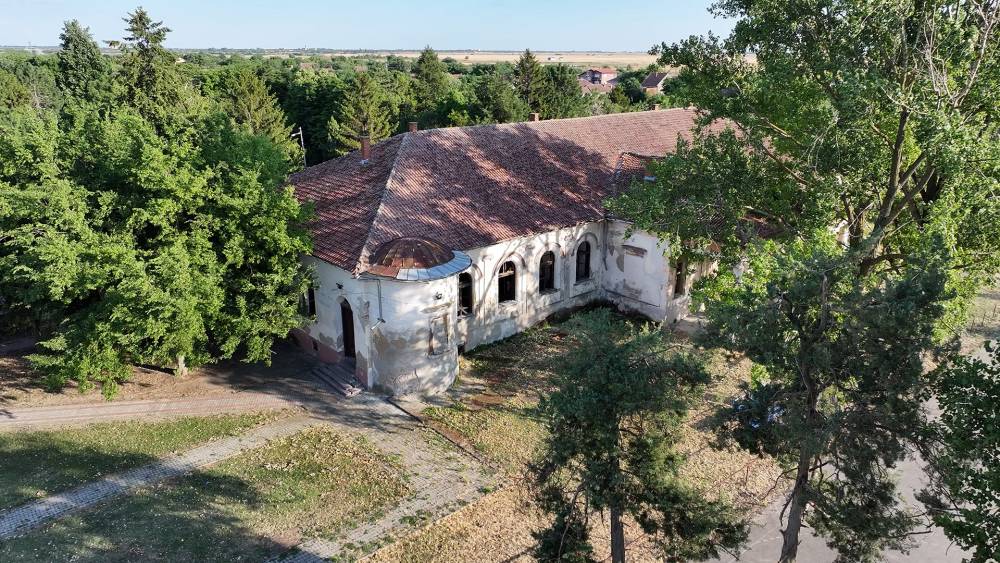
Hertelendi-Bajić Castle – Hertelendi-Bajer Castle
The castle was built by the Grand Župan of Torontál County, Jožef Hertelendi, at the beginning of the 19th century in the classical style. Bočar village and the 14th-century Telegdije castle were purchased by Spahi Jožef Hertelendi in 1803. In the following decades, most likely in the 1870s, during the tenure of Grand Župan Jožef the Younger, the building was modified with side domes and a courtyard portico.
The castle was built by the Grand Župan of Torontál County, Jožef Hertelendi, at the beginning of the 19th century in the classical style. Bočar village and the 14th-century Telegdije castle were purchased by Spahi Jožef Hertelendi in 1803. In the following decades, most likely in the 1870s, during the tenure of Grand Župan Jožef the Younger, the building was modified with side domes and a courtyard portico.
At the end of the 19th century, the estate passed to Baron Ivan Bajić (1863−1911), the nephew of Miloš Bajić, who lived on the estate until his death. Miloš Bajić was a great patron and philanthropist and founder of the Gymnasium in Novi Sad. The current Bajić Castle is a single-storey building with an elongated rectangular base, featuring elements of eclecticism.
The main façade has a simple stylistic design, with a central shallow risalit containing five window openings with architraves separated by shallow pilasters ending in Ionic capitals. In the courtyard, there is an entrance porch supported by six columns with Ionic capitals. Beneath the porch is a carriage passage. At the side ends, semicircular towers flank the building, giving the castle a distinctive and impressive appearance.
The estate with the castle was enclosed by a solid wall, of which only the decorative wrought-iron gate with columns has survived, topped by sculptures of two lions as guardians. Within the roughly 7-hectare enclosed estate were two castles, surrounded by an English-style park and economic buildings.
In front of the castle, on the street side, there was a village square (today a park), into which the main road ran in a straight line, making the castle visible from the village entrance. The interior was richly furnished, but little of the original appearance remains, except for carpentry fully preserved (doors and window wings with metalwork, frames in a classical manner, window sills, and shutters).
From the courtyard portico, one enters the foyer decorated with woodwork and Rococo stylizations on the walls. Today, the park behind Bajić Castle has been destroyed, replaced by a football field, and the building is locked. The castle once served as a school gym. Today it is unused, in very poor condition, and recorded as a cultural monument.
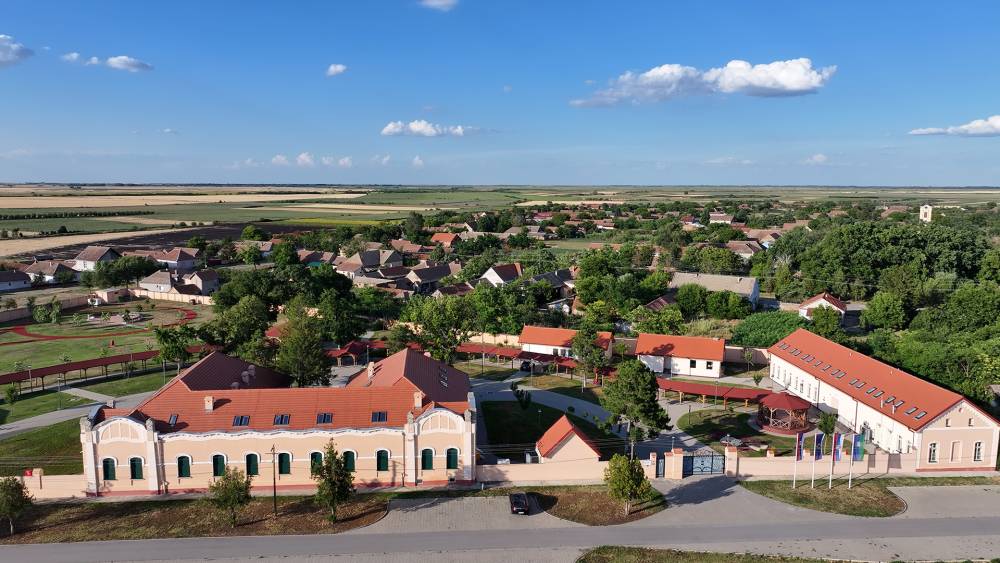
One of the best examples of how a neglected castle can be restored and given a new purpose is the Hertelendi-Bajer Castle, located in the village of Bočar. The castle was most likely built after the death of Jožef Hertelendi the Elder, when his three sons—Ignjac, Mikša, and Karolj—divided the estate among themselves. One of the sons built a building on this site.
Little can be said about the original appearance of the building, as there are no records, except for cadastral surveys of the village, which show that the building had a base in the shape of the Cyrillic letter P, as does the current building. The castle, along with the estate, was purchased at the end of the 19th century by brewer Olajoš Bajer, who transformed it in the first decade of the 20th century in the Art Nouveau (Secession) style.
The Hertelendi-Bajer Castle is a single-storey building with longer side annexes. The building was designed in the Secession style, with its design subordinated to the dominant style of the early 20th century. The corners are marked with side risalits with strong pilasters, ending in high semicircular attics, and a characteristic wavy cornice runs along the roof.
The park is partially preserved, and the complex included several economic buildings, of which one—a former stable—has survived and is now converted into a children’s annex. The castle housed a psychiatric hospital until recently and now functions as a center for children’s outdoor education. On the site of the former park are modern playgrounds for children.
The castle was renovated in a characteristic light-orange color with white frames around the windows, and the same color was used to accentuate other decorative elements on the façade. It is registered as a cultural monument, and the complete reconstruction of the castle was carried out under the expert supervision of the Institute for the Protection of Cultural Monuments. Since June 25, 2021, the building has been operational and serves as an example of how such a valuable architectural object can be repurposed and restored. The Provincial Government invested nearly 400 million dinars in its renovation.