Danijel Castle
Konak is a village that, by chance, came under the authority of the Archdiocese of Zagreb for lost properties in the Military Frontier around Zagreb and Karlovac. Kajkavian Croats were settled here and in the nearby village of Boka. This castle was built thanks to the Archdiocese’s decision to sell the land to the wealthy Danijel family, who moved from Transylvania to the Banat plains, then heavily settled and considered the “Midwest” of Europe.
Konak is a village that, by chance, came under the authority of the Archdiocese of Zagreb for lost properties in the Military Frontier around Zagreb and Karlovac. Kajkavian Croats were settled here and in the nearby village of Boka. This castle was built thanks to the Archdiocese’s decision to sell the land to the wealthy Danijel family, who moved from Transylvania to the Banat plains, then heavily settled and considered the “Midwest” of Europe.
Count Ladislav Danijel decided in 1898 to build a castle in the village of Konak near the bridge over the Brzava River. After the formation of the Kingdom of Serbs, Croats, and Slovenes, an agrarian reform took place, and Count Danijel sold the remainder of his land and moved to newly formed Hungary.
The attractive building was purchased by Belgrade industrialist Kosta Ilić, who converted it into a small garment factory, later inherited by his son Vlada, the last owner before nationalization. After 1945, the building became an orphanage, then a household building, and from 1959 the “Vuk Karadžić” primary school, which it remains today.
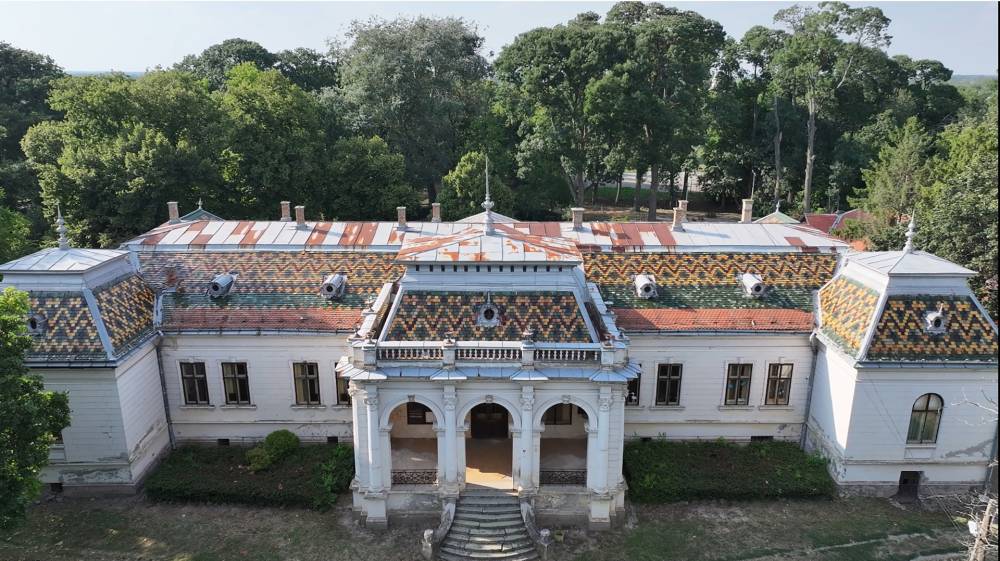
The castle is an example of neoclassical architecture where symmetry is the main principle. It also has elements of Art Nouveau – the striking roofs are decorated with recognizable Žolnai green and yellow ceramics. The main decorative elements on the façades are neoclassical porticos: the southern portico marks the exit to the park, while the northern portico is the main entrance. The southern portico is richly decorated with six Corinthian columns, while the northern has four Corinthian columns supporting a tympanum and side carriage entrances.
The arrangement of windows is rhythmic and aligned with the interior layout. The façades are ochre and white, and a small park surrounds the building, with various conventional Vojvodina trees as well as European and exotic species, primarily in the French style. The castle gives an impression of liveliness, is simple and harmonious. Since it houses a primary school, maintenance is solid, though much more work is needed.


