Kapetanovo Castle
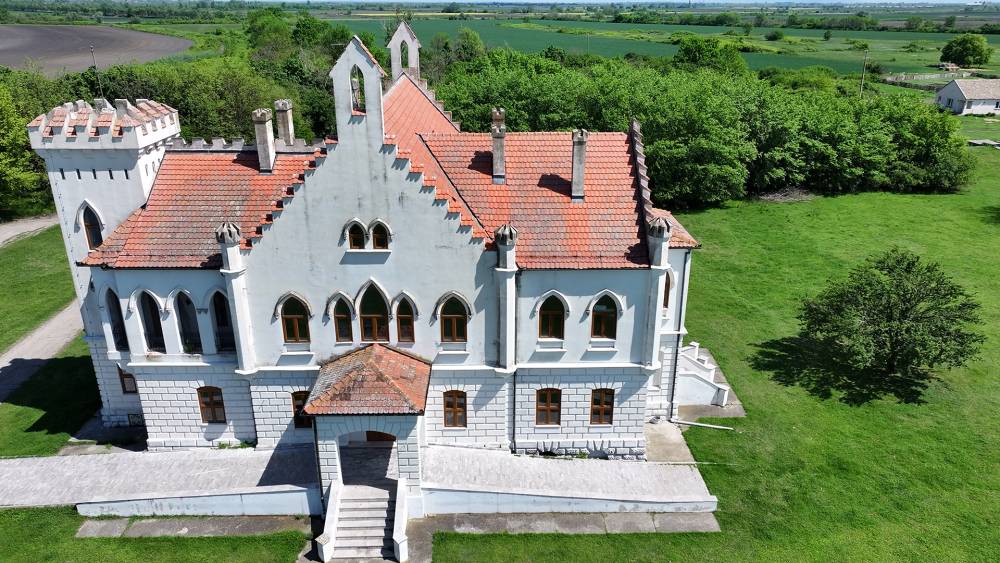
Kapetanovo Castle is located in the village of Stari Lec, municipality of Plandište, and was built in 1904. It is about 500 meters from the main road, in the middle of the Banat plains, and clearly visible from the road due to the absence of tall vegetation around it.
Kapetanovo Castle is located in the village of Stari Lec, municipality of Plandište, and was built in 1904. It is about 500 meters from the main road, in the middle of the Banat plains, and clearly visible from the road due to the absence of tall vegetation around it.
It was built by Count Bela Botka, born in Banlak in 1861, who settled in Banat after purchasing a large estate of 1,100 acres in central Banat. After the annexation of Vojvodina to the Kingdom of Serbia and later SHS in 1918, agrarian reform occurred, and Botka’s estate was halved. The family quickly lost capital, and in 1938 a Petrovaradin bank sold the furniture and the castle at public auction.
The castle was purchased by a merchant from Bočar, Franc Maj, and given as a dowry to his daughter Emilija. She married Milan Kapetanov, giving the castle its current name. Legend says Bela Botka went into debt because of expenses for treating his mentally unstable wife Ema, who often sought treatment in Pest, with Bela renting an entire train car for her trips.
A legend claims that in 1938, Ema could not bear the bankruptcy and loss of the castle, poured gasoline over herself, and set herself on fire, leaving only a lock of blue hair that “lingered around the castle.” In August 1938, each night the sky reportedly sparkled with shooting stars reminiscent of this tragic firework. Today, the lock of hair is said to occasionally appear on the grass or rakes, and the shadow of the blue-haired woman allegedly appears every year on St. Elijah’s Day.
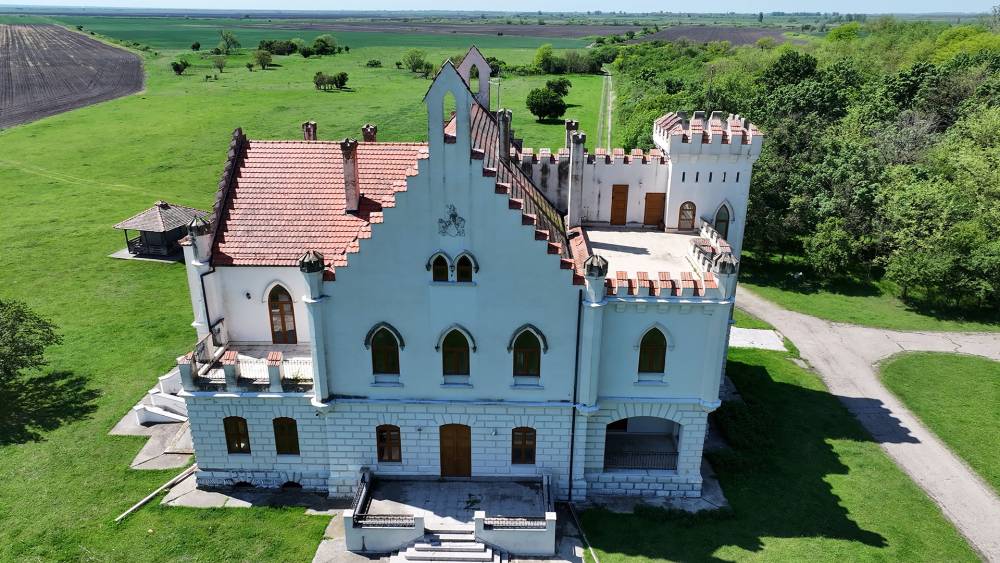
The castle is a manor house with a well-maintained park and fountain. The building is two stories, elongated, in the spirit of romantic historicism with elements of Romanesque and Gothic, an example of eclecticism. It is distinguished by a side tower and two tall symmetrical gables in the center of both main façades. Polygonal pilasters imitate turrets, reflecting Flemish and Hanseatic architecture. All windows have the same Gothic arches, and the white plaster imitates marble.
On the ground floor is a central hall with side staircases leading to a wooden gallery and upper-floor rooms for relaxation. The living room, kitchen, dining room, and library are on the ground floor. After World War II, the castle was nationalized and assigned to agricultural workers for housing. By the 1980s it was completely devastated, and the park was gone – only a cracked fountain remained. According to current information, it is privately owned by Radmila Jovanović, who renovated it. The castle is in excellent condition and open to tourists for a symbolic fee; it is also available for rent via Airbnb.