Schulhoff Castle
Schulhoff Castle is located 400 meters from the Tisa River, on the left side of the entrance to the village of Padej, looking from the direction of Ada and Mol. The new bridge, opened in 2010, replaced the ferry that had operated for two centuries, transporting people, livestock, and vehicles across the river. The castle was built in 1896 by the Schulhoff family, namely Lajos Schulhoff (born October 30, 1876, in Subotica, then Hungary), a wealthy Jewish landowner.
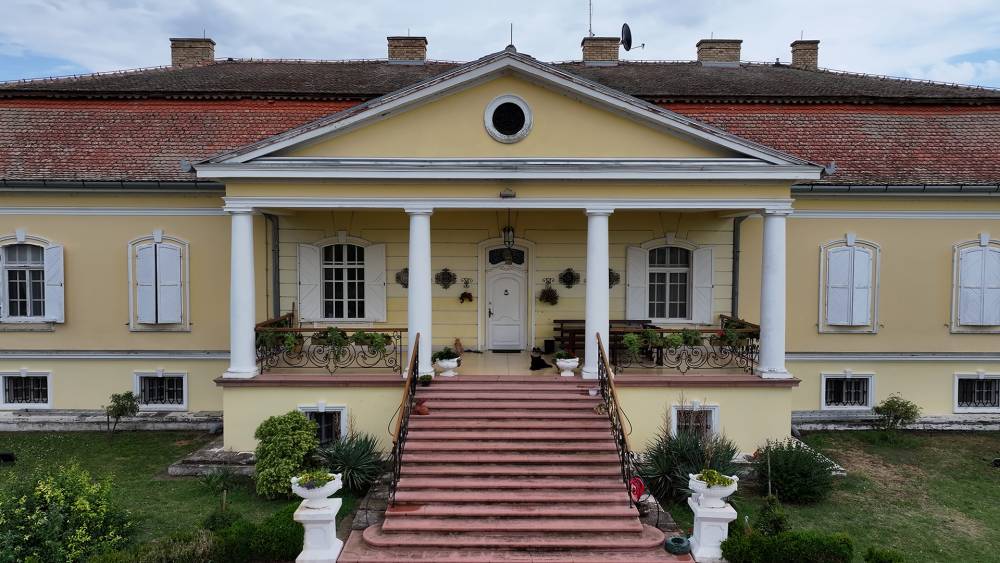
Schulhoff Castle is located 400 meters from the Tisa River, on the left side of the entrance to the village of Padej, looking from the direction of Ada and Mol. The new bridge, opened in 2010, replaced the ferry that had operated for two centuries, transporting people, livestock, and vehicles across the river.
The castle was built in 1896 by the Schulhoff family, namely Lajos Schulhoff (born October 30, 1876, in Subotica, then Hungary), a wealthy Jewish landowner. The “belle époque” period influenced northern Banat, prompting Lajos Schulhoff to purchase land in Padej, build a summer residence, and plant vineyards.
The castle was constructed in a classical style, while at the same time Gustav Klimt was founding the Vienna Secession in Vienna. Lajos Schulhoff adapted his castle to the aristocratic lifestyle, and his wine production became regionally significant, with exports throughout Hungary and France.
World War I brought changes, but the Schulhoff family continued to use their castle and estates. Lajos Schulhoff permanently settled in Padej in 1920. The castle employed more than 3,000 laborers to manage several thousand hectares of land and over 300 hectares of vineyards.
World War II again changed the castle’s fate: Lajos Schulhoff fled to Budapest, and the Nazis confiscated his property. The castle temporarily became the property of Hermann Göring. Lajos Schulhoff survived the camp and the war but did not return to Yugoslavia; in 1950 he moved to Montreal, Canada, where he died on June 13, 1962.
The castle was then acquired by the newly established agricultural cooperative in Čoka, while many valuable items were stolen. The castle “slept” until 2006, when Darko Višnjić purchased it from bankruptcy proceedings and began a two-year reconstruction, recovering up to 70% of the original furniture from local residents.
Today, Schulhoff Castle symbolizes the 20th century, from glory to ruin, and continues to live as a local cultural and historical landmark.
Source: kastelschulhoff.rs


